

How to Choose a Kitchen Faucet: The Complete Guide
Choose a kitchen faucet by matching it to the holes and mounting surface you already have, then checking where the stream, the handle and the spray hose can go. Bring the pot you fill and the sheet pan you wash into the decision. A model can fit the opening perfectly yet put the water on a sink divider or catch its hose on the trash drawer every evening.
If the old faucet is loose or leaking, leave it out of use and arrange repair. Keep everyone clear of a wet cabinet if the water may have reached wiring, an outlet or the disposal connection. Have an electrician make the area safe. For escaping water, use a known shutoff only if it is safe to reach from a dry place, and call a plumber. With an intact, dry installation you can plan by sight and with empty kitchenware. Leave the faucet and its connections assembled.
Quick answers
- Keep the working parts of the sink. Count the faucet holes separately from a dishwasher air gap, a dispenser you use or a drinking water tap you want to keep.
- Choose a comfortable parked position. You should be able to fill a glass or wash both hands with the spray head in its dock. Reserve the hose for jobs that need extra reach.
- Check both sides of the counter. The base and handle need room above. The clamp, water connections and moving hose need different kinds of room below.
- Verify the exact package. Ask for the model drawing, included plate and supply fittings. A finish name or an attractive photo cannot settle any of those questions.
What do you need the new faucet to do?
Start with yesterday's dishes. Perhaps you set a Dutch oven in the sink to fill it, then carry it to the stove. Perhaps you stand it on the divider because you cannot get it back out past the old spout. Those are different problems. The first calls for a stream over a stable spot. The second calls for an exit path with the spout swung aside. A taller faucet is only one way to change that path.
Choose one ordinary task and one awkward task. Filling a water bottle while holding the cap counts as ordinary. Rinsing the back corner after peeling potatoes might be the awkward one. Write down which hand normally holds the item and which hand is free. If you need one hand to hold a board and the other to keep a spray button pressed, you still need a way to adjust the water. A spray setting that stays selected could matter more than an extra spray pattern.
A portable dishwasher that couples to the faucet deserves a place at the top of that list. Check its connection instructions and the proposed faucet manual before trying any adapter. Delta's installation sheet 106557, revision H, specifically excludes portable dishwashers for the kitchen faucets it covers, including the Essa 9113 DST. A matching looking aerator thread would not change that restriction. If you rely on that dishwasher, choose a faucet and coupling that both makers support or ask your installer about an independently supplied appliance.
Which holes will still be available?
The deck is the horizontal surface where the faucet sits. On a drop in sink it may be part of the sink itself. On an undermount sink you may be looking at the counter behind the bowl. Sketch the deck as you see it from the front, including every button, cap, lever and spout. Label the items you intend to keep. An air switch for a disposal and a soap pump can look surprisingly similar from across a showroom.
A smooth base plate may conceal more than one factory opening. Look for the sink model or an installation drawing. From the open cabinet door, a light and a phone camera can sometimes show the underside without touching anything. A photo of a large nut at the center tells you where that faucet fastens. It does not tell you how many unused holes the plate covers. If the surface or hardware hides them, mark them unknown and get the layout confirmed before buying a faucet that depends on them.
A dishwasher drain air gap is another reason to make the sketch. KitchenAid's dimension guide for its KDTE324PPA dishwasher and related models shows this fitting beside the sink faucet and describes when the drain installation needs one. Keep an existing air gap available for its job. If you want to relocate it, ask the installer to check the dishwasher instructions and local requirements before counting its opening as free.
For three holes in a straight line, write down the center of the left opening to the center of the right one. Also record where the middle hole sits. On equal round openings you can measure from the left edge of the first opening to the left edge of the last to obtain the same center spacing. Using the two farthest edges instead adds a hole diameter. If the openings differ in size, mark each center separately on a paper sketch. Keep hole diameter and spacing as separate entries.
Will the plate sit flat and the clamp fit underneath?
A plate, also called an escutcheon, hides openings only within its footprint. Look at its length, its width from front to back and the shape of its ends. Lay a paper outline over the known hole positions. Include the nearby raised sink rim, the edge of a tiled backsplash and any lip around the faucet recess. A plate can reach beyond both outer holes and still leave part of a round hole showing at a tapered end. A curved ledge can also keep a gasket from contacting a flat surface all the way around.
Delta's current US drawing for the Essa 9113 DST kitchen faucet, revision D, gives an example. It shows 8 inches between the outside hole centers and an 11 inch plate. The older Delta revision B shows a 10 1/4 inch plate with the same centers. A household with a raised ridge 5 1/4 inches to either side of the center has 10 1/2 inches of flat length. The earlier length would fit between the ridges on paper. The 11 inch plate would extend past them. Check the part actually being supplied and its full footprint before relying on either number.
Package descriptions matter here. Delta's current sheet includes the escutcheon with the kitchen model and calls it a separate purchase for the prep model. An older Delta customer service answer on the recertified listing says to buy the plate separately. For a recertified or older box, ask the seller to identify the included plate and mounting hardware. For a sink with three holes, the price of a confirmed matching plate belongs in the comparison. For a sink with one hole, check whether the maker allows the smaller base alone.
The clamp underneath is a separate fit. Measure the actual stack the hardware must grip at the opening, from the faucet seating plane to the underside that will support the bracket. The decorative edge of a stone top may be built up and much thicker than the mounting point. Conversely, a sink ledge or backing in that spot can add thickness that the exposed counter edge misses. If the installed faucet hides the stack, mark its thickness unknown. Get the sink and counter section detail for that location or have the installer measure it before purchase. Keep the fasteners in place. Also check the underside drawing if the bracket must pass beside a deep bowl, a sink clip or a cabinet rail.
On that same Delta sheet the maximum deck thickness with the specified 11 inch plate is 2 1/2 inches. Delta gives 3 inches for the other configurations shown. With a measured clamping stack of 2 3/4 inches and three exposed faucet holes to cover, the plate installation exceeds its limit by 1/4 inch. The larger number cannot clear that combination. Choose a documented mounting arrangement for those holes and that thickness. Have a fabricator or installer assess a different mounting position before making any changes to the counter or its supports.
Where should the stream land for everyday work?
Set an empty glass in the bowl where you can hold it comfortably. Now hold a colander there as you would to rinse it. On a divided sink, try the bowl that you actually use for washing, even if the drain is on the other side. The best parked position often becomes obvious when you look at where your hands go. A drain in the far back corner is rarely a good reason by itself to put both hands back there all day.
Spout reach on a dimension drawing is a horizontal distance. Check its endpoints, usually the faucet center and the outlet center with the head docked. Mark the mounting center on a paper plan and lay out that distance toward your usual work area. A strip of card with a pencil dot for the outlet makes it easy to see where that point goes as the spout swings. Use only the swivel sector the model actually allows. For close decisions, check the direction of the outlet face as well. An angled stream can meet a lower surface away from the point directly underneath the outlet.
A large sink does not automatically need the longest available spout. Consider an offset faucet opening next to a narrow prep bowl. A long spout pointing forward might put the stream against the front slope. Turning it toward the large bowl could work until the swivel stops or the head crosses the divider. Mark a usable parked spot in the most used bowl first. A handheld rinse can serve the occasional far corner. Pulling the head out for every glass is a poor trade for reaching the last inch of an empty bowl.
A workstation sink adds a moving target. Slide the dry board or rack to its usual place and check that it leaves open bowl under the outlet. A solid board catching the stream can send water over the rim even though the projected outlet point is inside the sink outline. Change the parked spout position or the board layout on paper and see whether the surface still works for food preparation. Our spout reach measuring guide takes you through the reference points in greater detail.
Will the window open and the handle clear your hand?
Use two vertical dimensions. For overall height, start at the deck and measure up to the crown of the assembled faucet. Outlet height is the space from that surface to the docked outlet, as dimensioned on the model sheet. Neither tells you by itself whether your stockpot will come out of the bowl. A pot can sit well below the outlet once inside the sink yet catch on the spray head when you lift its handles over the front rim.
Make a side profile from card and hold it where the base would sit. Open the nearby window slowly with the mockup in place, stopping at the first contact. Include the sash lock, crank handle and projecting screen frame. A sill above the faucet leaves no useful margin if the lower corner of an inward opening sash sweeps through the arc. For that kitchen, compare another position the sink maker allows, a lower fixed profile, or a folding model with a documented parked height and room to fold. See how to choose kitchen faucet height for the pot and window measurements.
The lever has its own path. Find out which way it tilts to open the water and which way it travels from cold to hot. Include the space for your knuckles at the farthest position. A lever beside a backsplash can miss the tile but trap your hand. A soap bottle on the open side is easy to move. A window jamb, fixed filter tap or tall stone lip on that side calls for a different control position or model.
Kraus describes a 90 degree forward handle rotation on its Bolden KPF 1610SFS and advises against installing its handle on the left or front. Forward rotation can help a buyer with little room behind the lever. It still requires clearance in front of the lever and room beside it to operate the water. Mark the motion as shown for the installed orientation. If you prefer to use your left hand, try reaching the prescribed control with an empty pot under the mockup. Look for a documented left side option if you have to reach over the pot.
Which spout and spray head suit the way you rinse?
A fixed outlet keeps the hand holding the dish free to turn it under the stream. A swinging spout can park over either of two work areas within its rotation. If most of your washing is glasses and small pans, a fixed head with a well placed stream can be easier to live with than a wand you never take out. Check how you would rinse the bottom corners. A separate side sprayer can do that job but usually needs its own opening and room for its hose.
With a pull down faucet you draw the head down from its dock. Try that direction with a pot sitting under the outlet. If the pot rim leaves too little room for your fingers, the first move may be to swing the spout aside. A pull out wand comes toward you from its parked position. That movement may suit filling a tall container next to the sink, provided the container stands securely and you can return the head over the bowl before turning or releasing it. Use an empty container for this rehearsal.
For someone who frequently washes a sheet pan, try its real angle. Stand the dry pan in the bowl as it normally fits, grip it with one hand, and see where your free hand would hold the sprayer. A long handle can collide with the top of the pan. A small head can be harder to grip or point if its controls sit beneath your thumb. If possible, operate a dry showroom sample. Pay attention to whether you need to twist, hold a button continuously, or push it again to recover an ordinary stream.
Kraus says the spray toggle on that Bolden model stays in the selected mode while water is running and returns to stream when the valve closes. That can help someone who wants spray for an entire rinse and an ordinary stream for the next glass. It can disappoint someone who expects spray every time they reopen the faucet. Look up that detail on each model you compare. Two buttons in a photograph tell you little about what happens after shutoff. For more on the different designs, read which kitchen faucet types do which jobs.
Can the moving hose share the cabinet?
Draw the underside of the sink as it is on a normal evening. Include the disposal, drain trap, dishwasher hose, water stops, filter canisters and trash or compost bin. Note which parts move. A bin on a slide may sit well in front of the faucet mounting point with the drawer open, then travel into the space directly below it as the drawer closes. An empty installation photograph can make that cabinet look deceptively roomy.
A retracting hose needs a path out and back. On a weighted design, the loop changes shape and the weight travels as the head is drawn out and returned. The dock helps hold the returned head in position. Even a magnetic dock cannot bring the head within its grasp if the hose catches below the sink. Moen's support guidance specifically identifies obstructions catching the spray hose or its weight. Follow the mounting and routing drawing for your model. Leave both supply lines and the moving spray hose in their intended positions.
Use a side sketch to mark the space occupied by the bin with its drawer closed and the route it follows as it opens. Compare that space with the moving hose path and with the space needed to change a filter cartridge. If the basket is removable, measure with it back where it belongs. In a small cabinet a different bin can solve a collision, but moving the bin may block access to the shutoff. Test that decision on the sketch as well. If fixed equipment crosses the only route, choose a different hose arrangement or an outlet without a below deck spray loop.
Before buying a specialist hose guide, ask the faucet maker whether it supports one for the exact model. Moving a weight to a guessed position or tying a hose to a drain pipe can shorten travel. After a professional installation, have the installer demonstrate full useful travel and return with the regular storage back in place. Stop at resistance or new moisture. A repeat pull cannot tell you whether a hidden connection has moved. Keep the fixture out of use if there is a leak and have the installer trace it.
Will the water connections and controls work in this house?
For an existing kitchen, have the valve outlets and available route identified before choosing a connection option. Photograph a readable valve or connector marking from a safe, dry position. Leave the joints assembled. Ask for the faucet hose end specification, its sealing method and its usable length. The nominal size of the water pipe in the wall does not give you the outlet type on the shutoff. Matching a fraction printed on two labels is only a first check.
Delta's 9113 DST sheet specifies 3/8 inch compression fittings on its water supplies. That is a description a plumber can compare to the existing stops. A different seller might say only that half inch nuts are supplied. That leaves the mating thread and seal unresolved. If the maker cannot document both ends or the line will only reach by pulling tight around the bowl, have the installer price a supported solution or choose a model with a known fit. Have damaged, leaking or inoperable shutoffs addressed before faucet replacement.
Flow is another separate question. A spray that feels forceful at the pan does not tell you how quickly a pitcher will fill. Look for the rated flow and test pressure on the exact model and compare the same outlet mode. The Delta kitchen sheet, for example, rates maximum flow at 1.8 gallons per minute at 60 psi. That is a rating under stated conditions. Reduced flow on both hot and cold throughout the house deserves investigation before buying any sprayer on the promise of a faster fill. Our kitchen faucet flow rate guide explains how to compare a rated flow with a useful fill time.
With an electronic faucet, check what happens to the water if its power source fails. Moen's MotionSense power FAQ identifies two control boxes. For the box associated with adapter 169031 it says that both sensor and handle operation need power. A separate Moen quick start guide for a version with a temperature dial on the box says its handle continues working through a battery failure. Match the paperwork to the actual control box. If hand operation during an outage matters to you, get that behavior in writing or choose a mechanical control.
A powered model also needs a usable place for its battery pack or the power supply named by the maker. Can you reach the battery cover after the sink, bin and filters are in place? If the only nearby receptacle is switched with the disposal, it cannot supply constant power to an adapter that requires it. Moen makes that distinction in the same FAQ. Have an electrician assess any outlet changes. Include those costs and any approved adapter when comparing the sensor model with a mechanical one.
Will a filtered outlet replace a separate drinking tap?
For a kitchen with one available hole and an existing purifier, a faucet with a separate drinking water channel can save a second opening. Start with the purifier's model and outlet tubing, then the installation sheet for the new faucet. Find where drinking water enters, how the person at the sink selects it, and what additional connection or air gap the treatment system requires. Keep the original dispensing arrangement if the purifier maker cannot support the replacement. A photograph of a drinking glass under the spout cannot confirm system compatibility.
Home And Tower's deck mounted pull down faucet with a separate filtered water outlet illustrates the difference. For the Gold and Brushed gray selections, the supplier lists a brass body, ceramic cartridge and ABS plastic spray head. The word brass describes the body. Gold and Brushed gray name finishes. The photos show the same style of docked head and side lever in both colors. Neither the sheen nor the shape establishes the mechanism behind a button.
The supplier describes separate water passages and excludes the purifier and deck plate from the package. Its parts picture shows a connection with a retaining clip, but the listing gives no purifier fitting size and does not document which control starts the filtered water. Before treating this as a replacement for your present drinking tap, ask for the connection drawing and operating instructions. Give the seller the purifier outlet specification. If the seller can confirm the finish but cannot answer those two questions, leave this choice open and keep the current dispenser on your plan.
For a faucet that supplies drinking water, also ask for the exact model's US certification record. EPA's guide to lead free certification marks explains how to check a certifier's listing. NSF/ANSI/CAN 372 addresses the product's lead content, and NSF/ANSI/CAN 61 covers substances that can leach into the water. These are evidence about water contact materials. Any claim that a purifier removes a specific contaminant needs documentation for the treatment system and its cartridge. This store listing identifies no certification. Request the record before selecting it for drinking water or choose a documented alternative.
What will it cost to own and service?
Compare complete installations. One estimate might cover a factory plate and matching hoses. Another might require a plate, new stops or an approved power adapter. Ask the installer to separate the faucet swap from any changes to stone, plumbing or wiring. A low price on a faucet is of little value if the only way to seat it would remove support the sink needs. If you are replacing the sink too, have the sink, faucet and accessories laid out together before anyone cuts the new surface.
Look up the parts you can reasonably expect to need. On Delta's Essa kitchen page, the spray assembly, hose and docking magnet have separate part listings. Find the equivalents for your finalist and record the exact finish suffix for visible parts. A replaceable cartridge helps only if someone can identify it later and reach the retaining hardware. Ask who supplies the part, what proof of purchase is needed and whether removal and installation labor are covered. Keep a copy of the parts drawing with the receipt in a place that stays dry.
Ask for care instructions for the specific finish while you are comparing colors. For the Delta model discussed here, the installation sheet calls for gentle wiping with a damp cloth and drying with a soft towel. Choosing a dark or brushed finish does not give permission to use abrasive pads. If a close match with existing cabinet hardware matters, compare physical samples in your kitchen light. Put the sample beside the sink lip and the soap pump. Separate items sold as brushed can look quite different across that small distance.
Your next step
Bring one page of notes to the seller or installer. Record the usable hole pattern, flat plate area, clamping thickness and valve outlets. Add a sketch of the bowl with your usual glass position marked and a side view of anything that crosses the handle or hose path. Write the model and finish on the same page as its revision, drawings and parts list. That lets you return to a second candidate without accidentally pairing its shorter plate with the first faucet's mounting limit.
Compare the kitchen faucets against the job your sink has to do. A candidate earns its place when you can show where it fastens, park the stream where you work, use the lever with your free hand and give the hose a clear trip home. Keep any unanswered question next to the exact option. An answer from the maker about one fitting, plate or control can save you from discovering the difference with the old faucet already off the sink.
Kitchen Faucets in stock
 Galileo Galilei Swivel Spout Single-Hole Dual-Handle Kitchen Sink Faucet2 432,00 kr
 Werner Swivel Spout Pull-Down Single-Hole Dual Handle Kitchen Sink Faucet With Filter2 557,00 kr
 Richard Swivel Spout Single-Hole Kitchen Faucet1 746,00 kr
 Isaac Single-Hole Dual-Handle Kitchen Sink Faucet2 182,00 kr
 Max Swivel Spout Pull-Down Single-Hole Kitchen Sink Faucet2 130,00 kr
 Erwin 360º Swivel Spout Dual-Handle Single-Hole Kitchen Sink Faucet With Filter1 922,00 kr
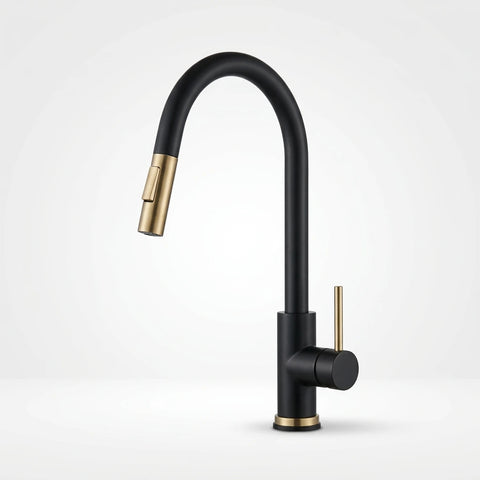 Albert Nordic Touch Sensor Pull-Down Single-Hole Kitchen Sink Faucet2 453,00 kr
 Michael Spring Spout Pull-Down Single-Hole Kitchen Sink Faucet2 026,00 kr
 Johannes Swivel Spout Pull-Down Single-Hole Kitchen Sink Faucet2 266,00 kr
 Edison Single-Hole Retractable Folding Kitchen Sink Faucet1 974,00 kr
 Abraham Pull-Down Spring Spout Dual Handle Kitchen Sink Faucet With Filter2 702,00 kr
 Neil Pull-Down Springs Spout Kitchen Sink Faucet2 151,00 kr


