

Pull Down Kitchen Faucets: How They Work and How to Choose
A pull down kitchen faucet lets you fill a pot with the spray head parked in the spout, then take the head in your hand to rinse the pot wall. Choose one by following the head from its resting place to the spot you want to rinse and back again. The length of a replacement hose tells you little about that trip. Before handling an existing fixture, stop if the base moves, the hose is damaged, a connection is wet or water is near electrical equipment. Leave that sink out of use. Stay clear of a wet electrical area and get qualified help. You can make the buying comparisons below on paper or at a dry showroom display.
Quick answers
- For filling, use the parked outlet. Mark where your bottle or pot can stand and see if the spout places the stream there with both hands free.
- For rinsing, measure from the parked head to the working position. Include the drop into the bowl and a little room to aim. A supply line length or a complete hose length answers a different question.
- For an easy return, follow the moving hose. Some models need a clear path for a weighted loop below the sink. Others carry a flexible arch to a dock on an arm.
- For a head that stays put, identify the dock. Feel how it releases and seats on the exact model. A magnet or a lock engages at the spout after the head has come back.
What moves when you take hold of the spray head?
On a faucet with a hose inside the spout, the arch provides a guide. The flexible line carries mixed water from the valve outlet to the spray head. Some of that line hangs below the sink. As you draw the head down, more line emerges from the arch and the hanging portion changes shape. When you guide the head home, the cabinet must have room to take that line back. The rigid pipes at the shutoffs and the two faucet supply lines have a different job. Leave them at rest. A hose that only appears to have room because it pushes a supply connection aside has a poor route.
There are three different jobs to look for. To reach a target, the hose needs enough free travel. To return, the hose needs both a clear path and whatever help the design provides, often a counterweight. To stay parked, the head has to meet and engage its dock. A design can do two of those jobs well and fail the third. A head that feels light on its way back but falls away from the spout as you take your hand off has told you something quite different from one that stops short with the hose still out.
The parts list for Waterstone's Traditional Extended Reach model 5500 makes the distinction easy to see. Its field guide identifies a sprayer hose, a sprayer counterweight and a sprayer lock assembly separately. Waterstone calls the last feature Positive Lock Pulldown. Its installation instructions require a free path for the hose and counterbalance below. An obstacle there can keep a perfectly good lock out of reach. Conversely, a case where the head meets the spout and fails to stay there calls for information about the lock before anybody considers changing the weight.
Another design carries the head at the end of an exposed flexible arch. The head comes away from a cup on an arm and the arch bends with your hand. Seeing the head move in a photo establishes very little about how much extra hose, if any, feeds through the counter. Look for a picture of the head away from the arm, the underside drawing and a statement of usable travel. If only the first is available, keep the question open. For a shallow prep bowl the bending motion alone might do everything you need. For a deep divided sink, compare how a pull down head and a pull out wand leave the spout before settling on a grip.
Which part of the sink needs water while both hands are busy?
Start with an ordinary job that uses both hands. You might steady a tall narrow bottle with one hand and a funnel with the other. Mark where the bottle stands stably in the empty bowl. Will the resting outlet point into the funnel there? This question comes before the spectacular photograph of the wand stretched over a wide sink. You can direct a hand spray toward the funnel, but at that point a third hand would have to hold something. Moving a light empty bottle an inch is easy. Balancing a partly full bottle on the slope beside the drain is a poor everyday solution.
Use the mounting hole center and the resting outlet center on a maker's drawing. Transfer those points onto a sketch of the sink at the same scale. If the spout swivels, mark a few positions of the resting outlet at that same distance from the base. A swivel can move the outlet around an arc. It cannot make the arc larger. The true water stream may angle away from the point straight under the outlet. A working showroom sample can settle that last question. If the sample is dry, record the outlet position and leave the direction of the running stream to confirm.
Delta's technical sheet for its manual Trinsic pairs a full kitchen faucet with a smaller bar faucet. The drawing for model 9159 puts the outlet 9 1/2 inches from the base center. Model 9959 on the same sheet puts it 6 1/2 inches out. Imagine a bottle that can stand only in a rack, with its funnel opening centered 9 1/2 inches directly in front of the mounting center. On paper the kitchen outlet sits over the mark. The bar outlet stops three inches short even when it faces straight forward. Both heads pull down. For that rack, only the longer model passes the first placement check. Check stream direction and funnel opening next.
Height needs two marks too. The top of the arch determines whether the faucet fits below a shelf or opening window. The height of the outlet and the bottom of the vessel determine the available filling space. A bottle standing on the bottom of a deep sink may fit where the same bottle standing on a drying rack will not. Sketch the surface you actually use. If the top of the container meets the wand before you can tip it upright, consider a different rack position or a faucet with suitable docked clearance. Longer travel does not lift a docked outlet.
Can the loose head reach the target with room for your hand?
For a hand rinse, choose a point on the item you wash and then choose where the spray face should be to reach it with water. Those are different points. Aiming a stream at the bottom of a pot from just below the rim takes less travel than bringing the head low beside the wall to rinse food off at close range. Set the empty, cool vessel where you usually wash it. Imagine holding the head rather than just touching a distant point with the last inch of your fingertips. Your knuckles, the spray angle and the rim all take space.
Here is a quick reason to measure in two directions. Suppose the head face must move nine inches sideways and twelve inches down from its parked position. The shortest straight path between those positions is fifteen inches. A head with a confirmed maximum displacement of fourteen inches cannot get there from that position, even if fourteen sounds generous beside the nine inch horizontal distance. A fifteen inch figure alone still leaves open whether the head can turn, whether the path clears the divider and where the maker measured the extension. Try swiveling the spout nearer the vessel first. Then measure again from the new resting point.
For a dry check, hold one end of a piece of soft cord at the proposed resting outlet. Have someone hold the other end where the face of the sprayer would need to be. Keep the intended opening clear. A cord just long enough to make a straight line will cut through the solid edge in some sink layouts. Route it clear of that edge and look again. The cord can reject an impossible route. It cannot reproduce the thickness of a wand or the stiffness of its hose. When the margin is small, take the pot dimensions and the required face position to a display of the exact model.
Waterstone gives two useful numbers for its 5500. The spout projects eleven inches, and the head can extend eighteen inches from the spout. Its drawing also identifies twenty inch supply hoses below the faucet. Those connect to the water supply. Do not use that twenty inch figure for spray extension. The older Waterstone 5500 sheet dated December 2017 also distinguishes the eleven inch reach and eighteen inch extension. A distance measured from the faucet base to the far end of a level tape is a different test from bringing the head over a deep pot and turning it back toward you. Keep the start and finish of every measurement beside the number.
What space does the cabinet give the moving hose?
Think of a pull down with a weighted loop as another moving object in the cabinet. Draw the fixed pieces first, including the drain, disposal if fitted and any filter housing. Next draw the parts that move during the week, including the refuse drawer, its lid and baskets that slide forward. A clear patch on the cabinet floor does not establish a clear path from the underside of the spout down to that patch. The loop has to pass the back of the bowl, then rise and fall alongside the other fittings.
For example, a bin on runners may sit toward the front when the drawer is open, with ample room behind it for the hose. When the drawer closes, the tall back lip sweeps through the lane that looked clear. A faucet demonstrated with the drawer open could return smoothly every time and still catch at home after dinner. Mark both positions with the bin in place on your sketch. If either overlaps the proposed path at the same height, change the storage layout or choose a design with a documented route that fits. Simply moving a bottle for the demonstration solves the wrong problem if the runner or bin wall is the obstruction.
For a sound, dry conventional manual faucet, have someone close the mixer handle and slowly guide the head while you watch from the open cabinet doorway. For a sensor equipped or electronic model, use a display confirmed to be inactive or ask the maker for its exact inspection procedure. Keep hands out of the moving loop and drawer. If the hose begins to pull on plumbing, a connector or a cable, stop the movement. If it passes cleanly over the limited distance you need, observe its return as well. Something that yields on the way out can catch on the way back. For a proposed installation with tight access, give an installer photos that show the drain, storage and proposed mounting point together. An overhead photo of an empty sink leaves all three out of view.
Waterstone's current Single Handle PLP instructions and its earlier Traditional PLP instructions both require the spray hose and counterbalance to travel without interference. Neither turns an obstructed cabinet into a suitable one. Delta's installation sheet for the manual Trinsic illustrates threading the hose through its weight. Even within the broad family of weighted faucets, the details of the weight and the connection matter. Do not copy a clamp location from a photograph of a different faucet, hang extra metal on a reluctant hose or tie moving pieces to fixed pipes. If the supplied path and specified parts cannot work in this cabinet, have the installation redesigned.
What does the supplier actually mean by reach?
Take two listings in the pull down collection. The brushed stainless steel swivel model has a solid arch with a head that slides out on a braided hose. Its supplier describes a hose about 47.2 inches long and says the wand extends more than 15.7 inches. A picture shows the hose emerging from the arch. Another lays out the loop beneath the body and a separate weight. These support the distinction between the whole length of the part and the portion available at your hand. They do not promise a clear 47 inch pull across the kitchen. Even the stated extension does not establish where the face will land in your cabinet layout.
The chrome version of the three finish flexible spout faucet presents a different question. The selected picture shows the shiny head against a side arm, below a black arch. The listing describes a magnetic cup. Its shared dimension sheet shows 553 millimeters from the counter to the top of the arch and 272 millimeters to the docked outlet. It also shows 225 millimeters horizontally from the outlet to the near face of the upright. If your drawing starts at the center of the mounting hole, ask for a center to center projection. Measuring from the near edge and from the center gives different answers.
That chrome listing supplies no dimension for travel after the head leaves the cup. The description of the head settling back on its support tells you how the supplier intends it to park. A picture of it already parked cannot establish whether it will find the cup by itself from your far basin. Guide any display head back, keeping hold of it. For a close rinse in a small bowl, ask to feel how the arch bends. If you need enough travel to reach a particular rack on the other side of a divider, give the seller the required displacement in both directions. Set this model aside for that job if the seller cannot confirm it.
A worthwhile seller question is short enough to answer with one photograph. Ask for a tape from the resting outlet to the same point on the extended head, with the spout position unchanged, plus a view of the hose path below if there is one. Ask whether a pictured length belongs to the complete replacement hose laid flat. If the only reply repeats a hose length from a parts listing, you still have no extension measurement. Keep the model on your list only for tasks its stated dimensions cover or that you can confirm on a working display.
Can you use the spray while you hold the dish?
Take the simplest controls first. The mixer lever sets water flow and temperature. The head controls the pattern on the models discussed here. A narrow necked container usually calls for a steady stream. A broad dirty surface can be easier to sweep with a wider spray when the face is close and aimed inside the bowl. A wide spray directed across the rim of a shallow tray can put water on the counter. Before paying for a third pattern, decide which of those two ordinary jobs is uncomfortable with your present faucet. Extra patterns will do little if it is hard to get the face into position.
Now consider the hand holding the head. On the Waterstone 5500, the manufacturer's product description says the wide spray is active while the lever on the handpiece is held. Picture steadying a colander with one hand while rinsing with the other. The hand on the wand has to aim, support the head and hold that lever for the duration of the rinse. Some cooks like releasing the lever to return to stream. Someone with a sore thumb may value a head with a verified spray setting that stays selected. Look at the selector from the side you will actually grip and ask to operate an unpressurized display for fit. A dry display cannot demonstrate which mode stays on with water flowing.
A pause feature can be handy when moving between bowls, but plan the task around the faucet handle as the control that shuts off the water. On the brushed swivel listing, the seller identifies a pause button along with stream and spray. It does not specify in that description whether the button must be held or what happens to the pattern on restart. Ask both questions if you rely on that feature. At an authorized working display, direct a modest, cool stream into the basin, change modes there and have the water turned off at the mixer when finished. Get the restart behavior demonstrated while the head is still aimed into the bowl.
What should a good return feel like at the sink?
At a secured dry display with the correct working hose underneath, take the head only as far as a normal rinse requires, then guide it home with a relaxed grip. Look at the instant the head reaches the spout. Does the face settle in the position you want for filling? Does it stay there as you ease your hand away? Next look at the button. You may like the face when it parks, yet find you must rotate the head every time to reach the control with your usual hand. Repeat the motion from the left and right sides of the bowl if both sides get regular use.
Delta describes magnetic docking on the manual Trinsic 9159. Waterstone describes a positive lock on its 5500. Each design has a way to retain the parked head and each has hardware that handles the hose below the sink. The words magnetic and locking identify different features to examine at the spout. Neither word assigns a specific return force to your hand across the full reach. Try the release movement with the grip you can comfortably use several times a day. If a shop has bolted the head to the display, you can still check its docked outlet position, but you need a different sample to assess the release and return.
For an existing faucet that used to work smoothly, identify the point where the behavior changed. A head that comes back to the mouth and then sags suggests a docking question. A head that moves freely for part of its travel before catching has made its first change somewhere along the route. The guide to a spray head that will not retract or stay docked follows those two clues separately. On Delta's Trinsic parts diagram dated November 2019, different pages apply to builds on either side of August 1, 2018. Find the actual product identification and production information before selecting a part. If the build date is missing or sits on the cutoff, send the maker a photo of the identification and the visible assembly. For example, the earlier 9159 illustration names steel weight RP49149. The later illustration names RP80523. A sales receipt dated years later cannot establish the manufacturing date.
Which compromises will matter after the first week?
Imagine two kitchens with the same size sink. One household uses a dish rack in the left bowl, leaving a narrow open space for a tall bottle. Its easiest upgrade may be the model whose docked stream lands in that space. Another household removes the rack and rinses a deep roasting pan on the bottom. It may favor the wand whose head reaches low enough to aim inward while the elbow stays comfortably above the rim. The same published extension can be irrelevant to the first household and decisive in the second. Write down which job has to succeed without rearranging your kitchen each time.
If counter space is tight, look beyond the bowl. A head might return squarely with the spout facing forward and contact a wall shelf or dish rack while you turn it toward the other bowl. Sketch the full height of the arch and mark what projects into its swing. Include the window latch in the position it occupies when the window is open. Compare with the actual product silhouette. If a collision only occurs at one extreme, decide whether all your tasks fit within the usable arc. If that blocked position is the one you need every evening, cross the model off.
Consider what happens when a wearable part needs service. Ask whether the maker identifies a replacement hose, the handpiece and the retaining piece for the exact version you would buy. On Waterstone's 5500 field guide, the lock and the counterweight have separate entries. That makes it possible to ask a precise question about a future repair without assuming that buying a complete faucet is the only option. A parts diagram shows identity. It does not guarantee current stock, a quoted price, a finish match or warranty coverage. For the handpiece, identify how the replacement spray head fits the hose and dock before accepting a substitute. Ask about the one part that would take the sink out of service if you need to plan around repair time.
Your next step
Take three notes to the pull down kitchen faucet collection. Mark where the parked stream must land, where you need to hold the loose head and what will move beneath the sink while the hose is returning. Beside each candidate, put the maker's measurement or the result of a display check for that job. If the head reaches the pan only by tugging the hose tight, try a different spout position or a different model. If it suits every hand rinse but leaves both hands occupied to fill your everyday bottle, choose for the bottle. The best reason to buy a pull down is the work it makes easier at your own sink.
Pull Down Kitchen Faucets in stock
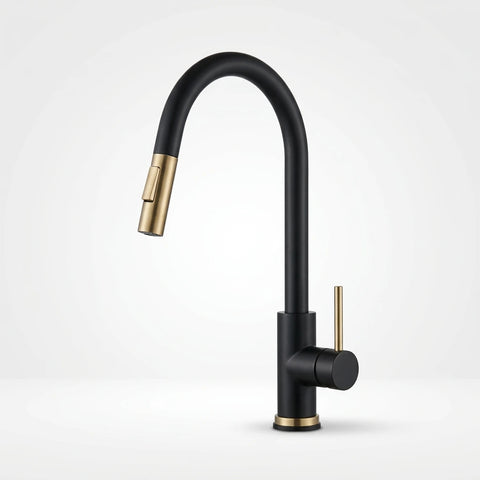 Albert Nordic Touch Sensor Pull-Down Single-Hole Kitchen Sink FaucetCHF 200.00
 Michael Spring Spout Pull-Down Single-Hole Kitchen Sink FaucetCHF 165.00
 Neil Pull-Down Springs Spout Kitchen Sink FaucetCHF 175.00
 Abraham Pull-Down Spring Spout Dual Handle Kitchen Sink Faucet With FilterCHF 220.00
 Werner Swivel Spout Pull-Down Single-Hole Dual Handle Kitchen Sink Faucet With FilterCHF 208.00
 Deck Mounted High Arc Pull Down Kitchen Faucet with Three Spray Modes in Gun Gray or ChromeFrom CHF 293.00
 Deck Mounted Brass Pull Out Kitchen Faucet with Double Swivel Arm in Chrome or Black and ChromeCHF 688.00
 Deck Mounted Brass Pull Down Kitchen Faucet with Three Function Sprayer in Three FinishesFrom CHF 497.00
 Deck Mounted Brass Pull Down Kitchen Faucet with Flexible Spout and Magnetic Dock in Three FinishesFrom CHF 633.00
 Deck Mounted Brass Pull Down Kitchen Faucet with Red Flexible Silicone Spout in Four FinishesFrom CHF 527.00
 Deck Mounted Brass Pull Down Kitchen Faucet with Black Flexible Spout in Three Brushed FinishesFrom CHF 743.00
 Deck Mounted 3 in 1 Brass Kitchen Faucet with Pull Out Sprayer and Filtered Water NozzleFrom CHF 729.00


